The Little ThesisA Coloring Adventure in Research
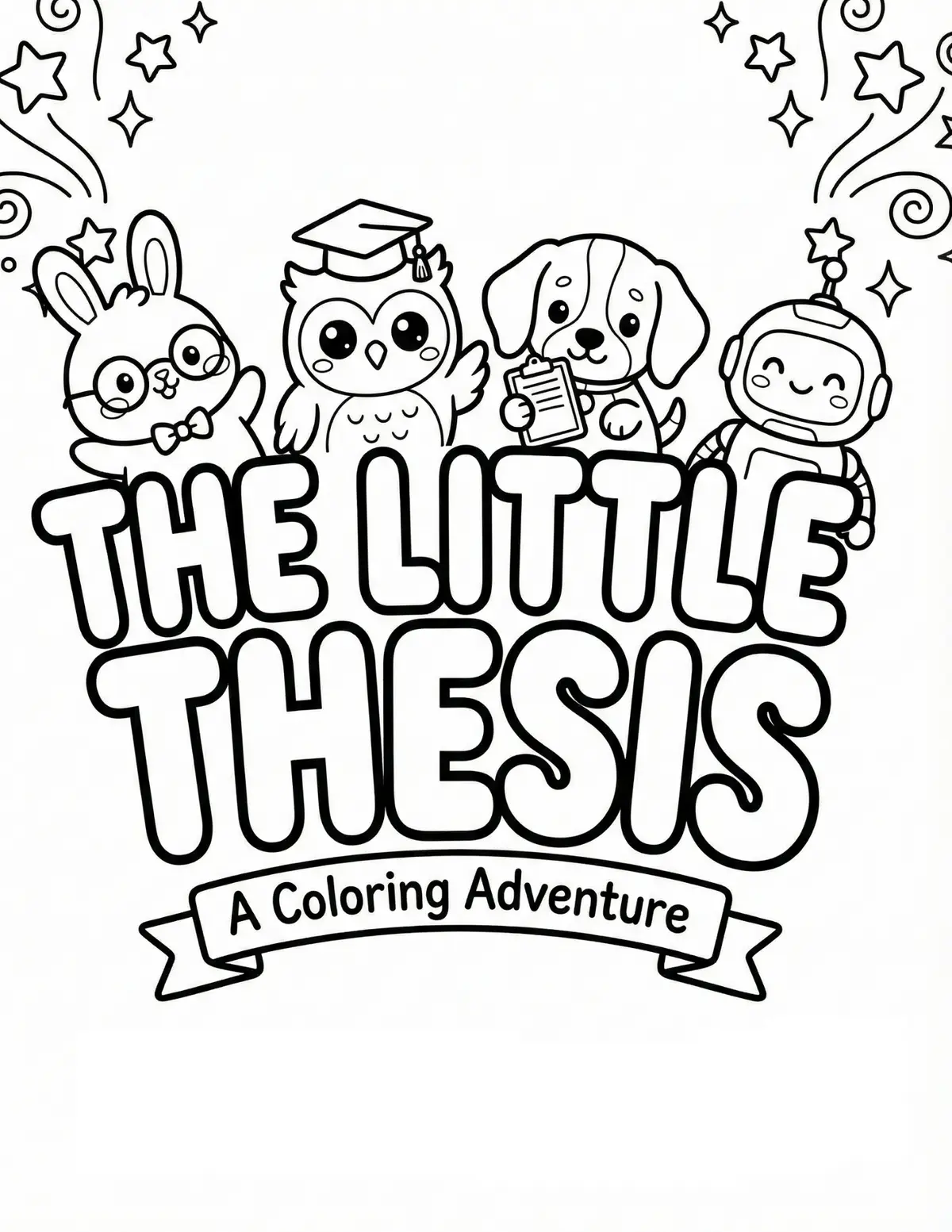
100 coloring pages that walk ages 4 to 8 through how research actually works, from "I wonder why" to a Junior Researcher diploma. Six chapters, four guide characters, one crayon-friendly story your kid completes.
Available on Amazon • Paperback • 100 pages • Ages 4 to 8
Research literacy starts younger than you think.
The Problem
Most kids do not see how science actually works until middle school. By then, half have decided they are “not a science kid.” The story of research, the questions, the careful steps, the failures, the diploma at the end, lives behind a door they think is for someone else.
The Solution
The Little Thesis teaches the six-step research process before they are 8. 100 pages of crayon-friendly thinking like a scientist, four guide characters kids fall in love with, and a Junior Researcher diploma they color themselves. Research becomes something they did, not something other people do later.
Six chapters. One real research project.
Every coloring page belongs to a stage of the research process. The book is a structured story arc, not a random pile of activities.
Chapter 1: Observation & Questions
Notice something odd. Wonder why. The book starts where every real research project starts.
Chapter 2: Literature & Tools
Look up what is already known. Meet the library, the microscope, and the telescope.
Chapter 3: Hypothesis
Make a guess you can test. The first chapter where kids commit to a prediction.
Chapter 4: Experiment Planning
Decide how to find out. What to measure, what to keep the same, what to change.
Chapter 5: Data & Patterns
Sort what you found. Color charts. Spot the pattern hidden in the numbers.
Chapter 6: Writing & Peer Review
Write it up. Catch your own errors. Earn the Junior Researcher diploma.
Meet the research team.
Every role a real research team needs: the questioner, the mentor, the systems thinker, and the editor.
Curious Cat
The Questioner
Carries a magnifying glass. Asks "why" and "what if." Models the curiosity that starts every research project.
Professor Hoot
The Mentor
Knows the library, the tools, and the prior literature. Shows the team how to learn what is already known.
Subby the Robot
The Data Organizer
Counts, sorts, charts. Turns the messy pile of observations into patterns the team can see.
Detail Dog
The Editor
A beagle analyst. Catches errors, sharpens the writeup, and runs peer review so the work holds up.
Why this works for kids.
Coloring locks in the concept
Hand work anchors abstract ideas. A child who colored the hypothesis page remembers what a hypothesis is. Each page becomes a souvenir of what they learned.
A diploma closes the loop
Completion ritual matters at this age. Kids finish the book with proof they did research, not proof they colored a book. The identity shift is the point.
Built for NGSS K-2 classrooms
Maps cleanly to K-2 science practices: asking questions, planning investigations, analyzing data. Sits beside the curriculum, does not compete with it.
Built for the people teaching the next generation.
Parents
For the parent who wants their kid to see research as something they can do, not something other people do later. A real story arc, not a scattered activity book.
K-2 Teachers
Cross-curricular STEM that fits in 20-minute slots. Hand it out as morning work, station rotation, or substitute lesson. Each chapter maps to an NGSS K-2 science practice.
Researchers & Grad Students
The thoughtful gift for the niece, nephew, or student’s kid you keep meaning to mentor. A way to share what you do without lecturing about it.
Start the Research Adventure
Give a child a real research project they can color. Six chapters, four characters, a diploma at the end, and a head start on thinking like a scientist.
Paperback • $9.99 • Available Now