Case Study · Website Design
Rebuilding a Ventura MMA Gym Website, Starting With Research
Rock N Roll Fight Company has trained fighters in Ventura, California since 2008, but the gym's websites and its domain had lapsed. We recovered the domain and rebuilt the site from the ground up in about two weeks, starting with research the way we would start a study. The site was a gift.

At a Glance
- Location
- Ventura, California. The gym was founded in 2008.
- Goal
- A fast, search-friendly home that tells the coach's story and starts a direct conversation over Instagram or phone
- Starting point
- No live site. Earlier sites on Wix, a frameset, and a site builder had lapsed, along with the domain.
- Subthesis role
- Research, strategy, design, build, launch, search setup, and post-launch fixes
- Timeline
- Research began September 9, 2026. Launched on the original domain September 22, 2026.
- Stack and tools
- Astro static HTML, SCSS, TypeScript, GitHub Pages, Google Search Console, Bing Webmaster Tools, and a Rankability workspace for ongoing search tracking
- Cost to the client
- None. The site was a gift.
The Challenge
Rock N Roll Fight Company has trained fighters in Ventura County since 2008, but by 2026 it had no website. Its earlier sites had come and gone on Wix, a frameset, and a site builder, and the domain had lapsed. Anyone searching for the coach found scattered directory listings, some blocked or out of date.
The gym was also between physical spaces, with the coach traveling to clients for one-on-one sessions. The site had to explain that model, earn trust with people who had never met him, and turn a visit into a message, without forms, a server, or prices on the page.
Research First
We treated the build like a study. About 25 public sources were checked and logged with a fetch status, and every fact about the coach and the gym got a confidence rating: confirmed by several independent sources, found in one listing, or inferred and flagged to confirm with the client.
The Internet Archive recovered four eras of the old websites. The 2020 copy held the About page in the coach's own words, which became the voice of the new site, along with 36 original photos. All 37 recovered images were catalogued one by one, with privacy flags for anyone who should not be identified.
Two scripts found and analyzed 22 competing gym websites across the county. Most ran on site builders, none of the six in Ventura had a real blog or a coach story, and only one was a fast static build. That gap set the strategy: a real blog, a real coach story, and a conversation instead of a free-trial pitch.
Timeline
- 1
Discovery and research (September 9)
Public sources logged with confidence ratings, old sites recovered from the Wayback Machine, 37 images catalogued, 22 competitor sites analyzed, and an interview sheet written for everything the public record could not answer.
- 2
Strategy, architecture, and design system (September 9)
The voice taken from the coach's own taglines, a conversation-first call to action, a static stack chosen for search and AI answer engines, and color, type, and motion tokens drawn from the gym's original logos.
- 3
First prototype (September 9)
A single long home page with 13 sections, a blog with RSS, structured data, a sitemap, llms.txt files, and a pipeline that builds and publishes the site on every push.
- 4
Domain recovered (September 21)
The gym's own former domain was bought back, so old links and search history point to the new site.
- 5
Restructured into real pages (September 21 to 22)
One page became many, each with one job: a home page told as a five-beat story, About, Training, Fighters, a Fight-Day Corner service, booking, ten city pages, and a help center that grew to 113 answers.
- 6
Quality gates and launch (September 22)
Automated checks for valid HTML, heading order, dead links, nofollow on external links, and sitemap and llms coverage now fail the build on any violation. The site launched on the original domain with Google Search Console and Bing Webmaster Tools verified.
- 7
Post-launch fixes (September 22)
A mobile layout overhaul, descriptive image names and alt text, an SEO audit of all 148 pages traced to its causes and fixed, the help center rewritten in the coach's first-person voice, and phone menu fixes.
What Subthesis Built
A 148-page static website
Real HTML on first load for every page, hosted on GitHub Pages with no server to maintain.
A story-led home page
Five beats: the visitor, three barriers (knowing where to start, gym hours, and trust), and the coach as the answer.
Ten service-area pages
One page for each Ventura County city served, each with its own local detail and FAQs.
A help center in the coach's voice
113 answers across 11 topics with instant search, written in the coach's own voice.
Search and AI-answer readiness
Structured data, XML and readable sitemaps, llms.txt files, IndexNow, and verified Google Search Console and Bing Webmaster Tools accounts.
A design system from the original brand
Color, type, and motion tokens drawn from the gym's logos, with every text pairing meeting 4.5:1 contrast.
Automated quality gates
Lint and build checks that stop invalid markup, broken links, and missing search metadata from being deployed.
A complete build record
A written account of every phase, decision, and open item, so anyone can maintain the site.
The Finished Site
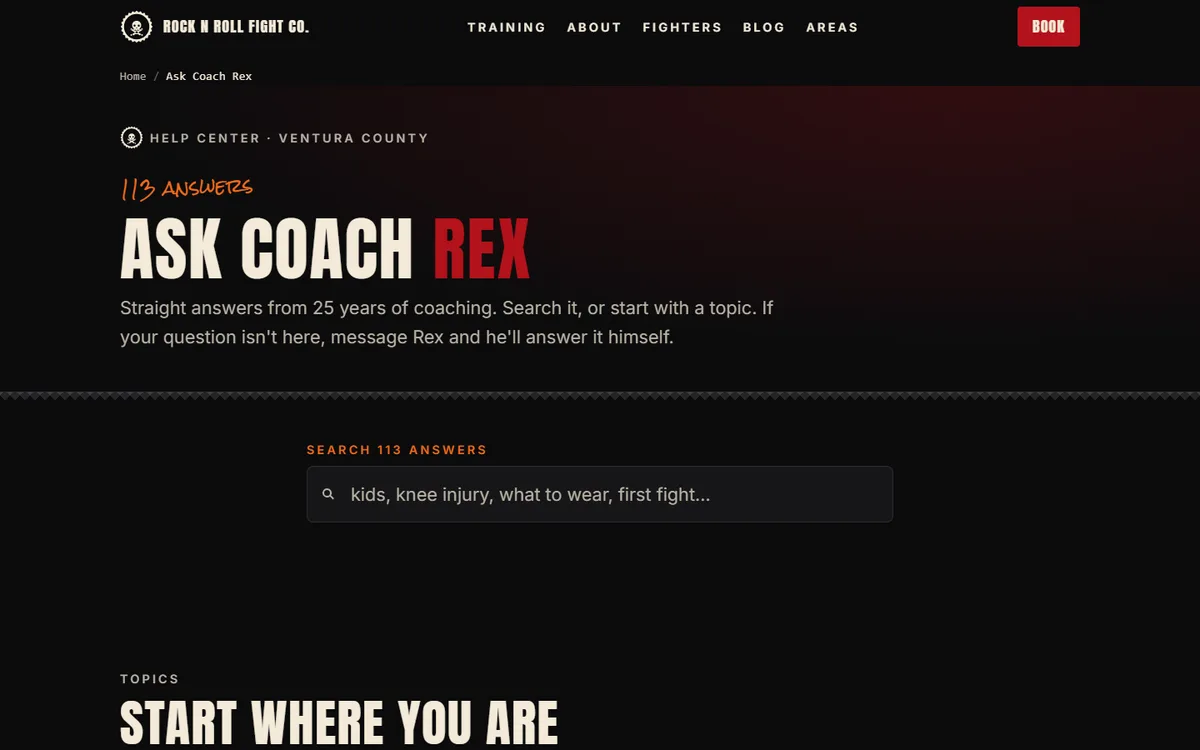
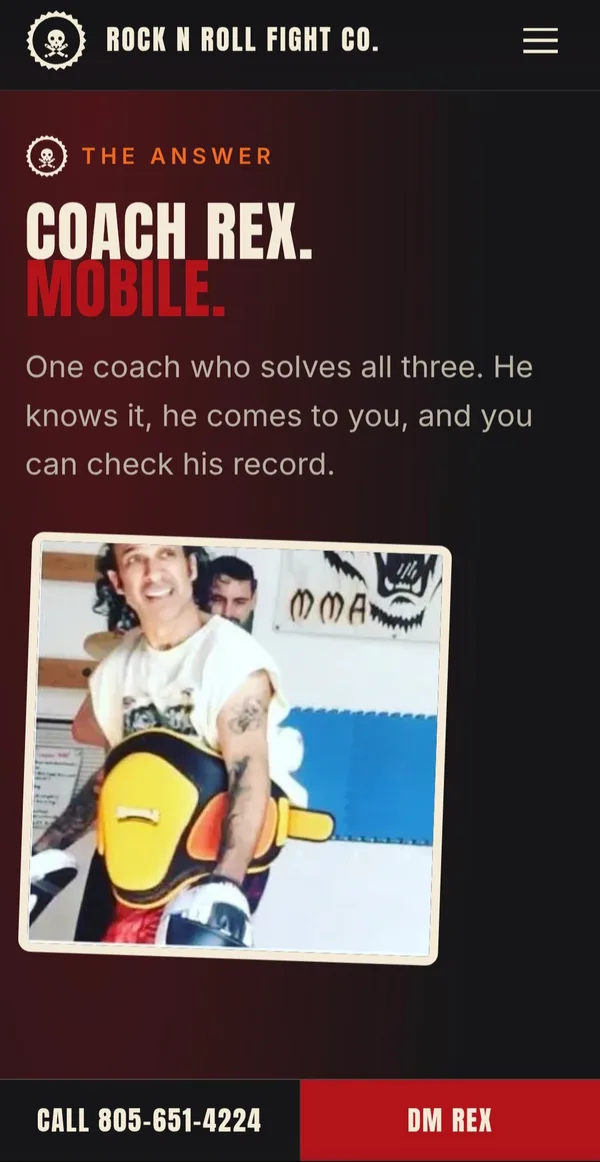
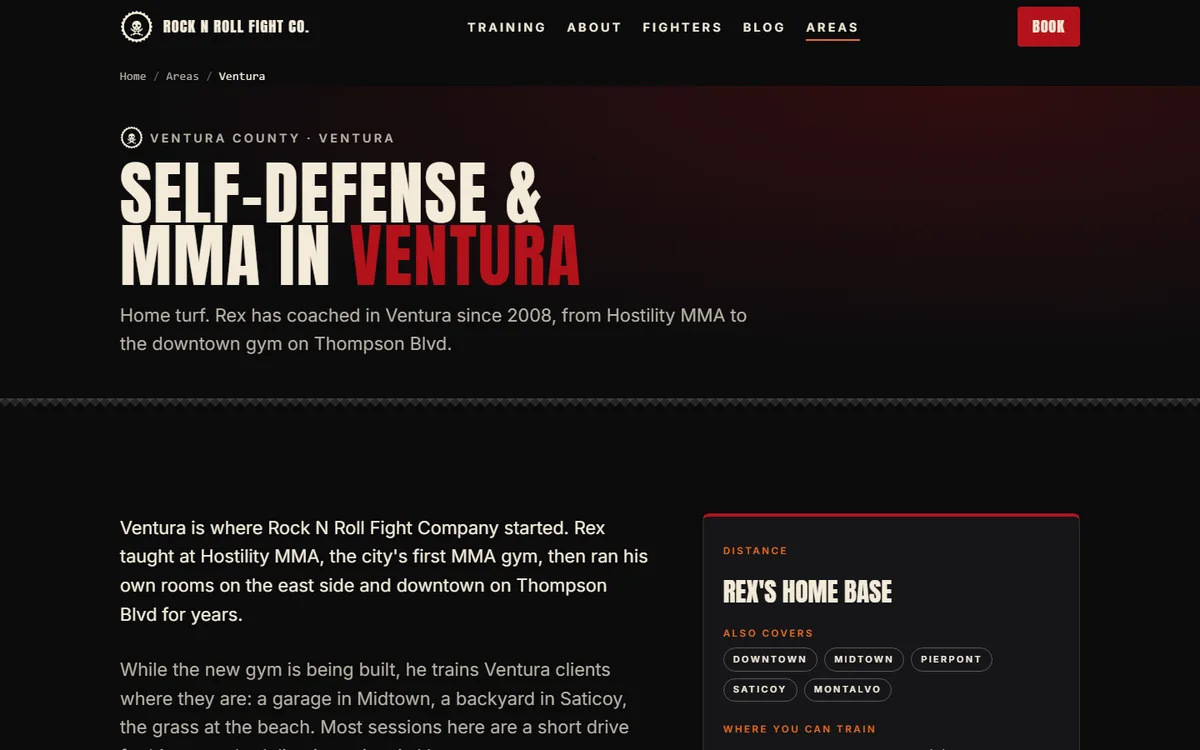
See it live at rocknrollfightcompany.com.
Results
The gym is back on its own domain with 148 pages, each with a title, description, canonical URL, and structured data. An SEO audit of every page raised 22 critical findings. All were traced to five causes and fixed, bringing long titles, mismatched titles, and out-of-range descriptions to zero and adding 328 internal links.
The site is fast by design. The hero image dropped from 315KB to 116KB on desktop and 28KB on phones, and the help center index ships 28KB instead of 95KB. Every section works with JavaScript turned off.
The site is now tracked in a Rankability workspace, alongside Google Search Console and Bing Webmaster Tools, so its search visibility can be measured as it grows.
Some items stay open on purpose and are tracked in the build record, including confirmations from the client before certain photos and stories are used, a vector logo, and the rest of a ten-post blog calendar.
What We Learned
Research before design
Logging sources and rating confidence meant the site was built from real facts and the client's own words. Anything uncertain was written around instead of invented.
Turn rules into checks
Every standard that mattered, from heading order to nofollow links to sitemap coverage, became an automated check, so quality does not depend on remembering.
Frequently Asked Questions
How long did the website take to build?
Research and the first prototype were done on September 9, 2026. The domain was recovered on September 21, and the full site launched on September 22, with post-launch fixes the same day.
Why a static site instead of WordPress or Wix?
Static HTML gives search engines and AI answer engines real content on first load, loads fast, and costs nothing to host. The strongest competitor site in the area was also a static build.
What is llms.txt, and why does it matter?
It is a plain-text index of a site written for AI answer engines. Together with structured data and sitemaps, it helps tools that answer questions directly find and quote the right pages.
Can you build a site like this for a nonprofit or a research lab?
Yes. The same research-first process works for a nonprofit's mission, a grant-funded program, or a lab's projects and publications. Each project is quoted as one flat fee.
Need a website for your mission or research?
Our Website Design service builds accessible, search-ready sites for nonprofits, research labs, and grant-funded projects. Always one flat fee, quoted after a scoping conversation.
See the Website Design service →