The Dissertation Feedback WorkbookWalk in with an agenda. Walk out with a record.
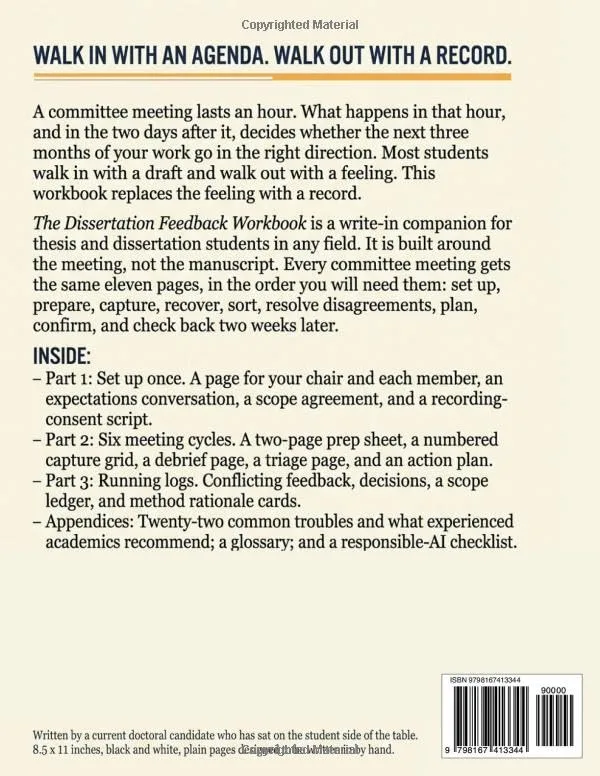
A committee meeting lasts an hour. What happens in that hour, and in the two days after it, decides whether the next three months of your work go in the right direction. Most students walk in with a draft and walk out with a feeling. This workbook replaces the feeling with a record.
Available on Amazon • Paperback • 114 pages • 8.5 x 11 inches
The meeting is an hour. The next three months depend on it.
The Problem
Most students walk into a committee meeting with a draft and walk out with a feeling. Comments come from several people at once, some contradict each other, some are suggestions that sound like requirements, and "tighten this" means something different to everyone in the room. Two weeks later, nobody remembers the same meeting.
The Solution
The Dissertation Feedback Workbook is built around the meeting, not the manuscript. Every committee meeting gets the same eleven pages, in the order you will need them: set up, prepare, capture, recover, sort, resolve disagreements, plan, confirm, and check back two weeks later.
Three parts and three appendices. Every page meant to be written in.
114 plain pages designed to be filled in by hand, 8.5 x 11 inches, black and white. Purchasers may photocopy the worksheet pages for their own use.
Part 1: Set up once
A page for your chair and each member and what they care about, an expectations conversation, a scope agreement, an AI-use agreement with your committee, a recording-consent script, and a bank of questions worth asking in any meeting.
Part 2: Six meeting cycles
A two-page prep sheet, a numbered capture grid (who said it, what they said in one line, Required / Suggested / Unclear, and where in the document), a debrief page, a triage page, a page for when members disagree, an action plan, a 48-hour confirmation email template with a one-page summary, and a two-week check-in.
Part 3: Running logs
Logs that carry across meetings: conflicting feedback, decisions, a scope ledger for every "have you considered adding...", revision rounds by chapter, an advisor contact log, an AI-use log, a citation verification log, milestones and forms, and method rationale cards that double as defense preparation.
Appendix: Twenty-two common troubles
Conflicting feedback, vague feedback, a silent advisor, moving goalposts, scope creep, harsh delivery, a member who wants a different dissertation, and more, each with practical steps to try.
Appendix: A glossary of committee phrases
Decodes phrases like "needs more work" and "tighten this," and the softened language that hides a hard message.
Appendix: Responsible AI
A responsible-AI checklist with a disclosure template, to go with the AI-use agreement and log in Parts 1 and 3.
See two pages, filled in.
Here is what the capture grid and the 48-hour confirmation summary look like after a typical meeting. The student, committee, and comments are invented to show how the pages work.
Illustrative example · fictional student and committee
Capture grid, meeting 2
One line per comment: who said it, what they said in a few words, whether it is Required, Suggested, or Unclear, and where in the document it applies.
| # | Who | What they said | R / S / U | Where |
|---|---|---|---|---|
| 1 | Chair | Narrow RQ2 to one district | Required | Ch. 1, p. 6 |
| 2 | Member A | Add a power analysis for the survey | Required | Ch. 3, sampling |
| 3 | Member B | Consider a mixed-methods design | Unclear | Ch. 3 |
| 4 | Member A | Recent sources on teacher retention | Suggested | Ch. 2, section 2.4 |
| 5 | Chair | Asked about IRB timeline | Unclear | Timeline |
48-hour confirmation summary
Sent two days after the meeting so the record is in your words, with a request for corrections.
Subject: Summary of our October 14 meeting
Thank you all for your feedback. Here is my understanding of what we decided:
1. I will narrow research question 2 to the Lincoln district only (Required).
2. I will add a power analysis to Chapter 3 before the next draft (Required).
3. Dr. B, could you say more about the mixed-methods suggestion? I want to check whether it is a requirement for approval or an option to consider.
4. I will add recent retention sources to section 2.4 where they fit (Suggested).
Revised Chapters 1 to 3 by November 18. Please reply with any corrections by October 21.
Three rules do most of the work.
Required, Suggested, or Unclear
Mark every comment as one of the three, and ask about the unclear ones before the meeting ends, while the person who said it is still in the room.
Wait 48 hours before you sort
A short pause makes it easier to judge each comment on its merits. The debrief page catches what you heard right away; the triage waits.
Write the record yourself
Within two days, send a short numbered summary of what was decided and ask for corrections. A written summary is a widely recommended practice, and it gives everyone the same record to check.
For any field and any committee structure.
Thesis and dissertation students
Master's and doctoral students in any field who meet with a chair, an advisor, or a full committee and want every meeting to end with a written, agreed record.
Any committee structure
Chair and members, supervisor and co-supervisor, or a panel with external examiners. US and UK terms are mapped on the first pages.
Written from the student side of the table
Written by Angel Reyes, a current doctoral candidate who has sat on the student side of the table, for students who would rather walk out with a record than a feeling.
How the workbook compares with other ways to track feedback
Any method that leaves you with a written, agreed record is better than memory alone. Here is what each common approach covers.
Ways to keep track of committee feedback
| Approach | What it does well | What it leaves out |
|---|---|---|
| Notes app or a plain notebook | Quick to start, always with you | No structure for sorting, disagreements, or follow-up |
| Spreadsheet feedback tracker | Sortable log of comments and status | No meeting preparation, debrief, or confirmation steps |
| Recording the meeting, with consent | A complete account of what was said | Still needs to be turned into decisions and actions |
| The Dissertation Feedback Workbook | The same eleven pages for every meeting, from preparation to a 48-hour confirmation summary, plus logs across meetings | It is a paper workbook, so digital copies need photocopying or scanning |
Frequently Asked Questions
How do I keep track of dissertation committee feedback?
Capture each comment in one line with who said it, mark it Required, Suggested, or Unclear, and note where in the document it applies. Ask about unclear comments before the meeting ends, then send a short numbered summary within two days and ask for corrections. The workbook gives you a page for each of these steps.
What should I do when committee members disagree?
Record each position with who said it, then ask your chair how to resolve it, ideally before you revise. Confirm the decision in your written summary. The workbook has a page for disagreements in every meeting cycle and a running log of conflicting feedback.
Is the workbook useful for a master's thesis?
Yes. It works for master's and doctoral students in any field who meet with a chair, an advisor, or a full committee. US and UK committee terms are mapped on the first pages.
Does it cover using AI in my dissertation?
Yes. It includes an AI-use agreement to discuss with your committee, an AI-use log, and a responsible-AI checklist with a disclosure template.
Can I copy the worksheet pages?
Purchasers may photocopy the worksheet pages for their own use.
Walk In With an Agenda
Eleven pages for every meeting, logs that carry across all of them, and twenty-two common troubles with what to do about each. Walk out of your next committee meeting with a record instead of a feeling.
Paperback • 114 pages • $19.99 • Available Now