The Little Thesis 3The Garden Report
The pigeon brings a letter: the Tortoise who funded the garden wants to know how it grew. 101 coloring pages take ages 4 to 8 through a real research report, from counting the harvest and asking the neighbors the same questions again to comparing before and after, finding out why the pumpkins stayed small, and sharing what worked and what did not.
Available on Amazon • Paperback • 101 pages • Ages 4 to 8
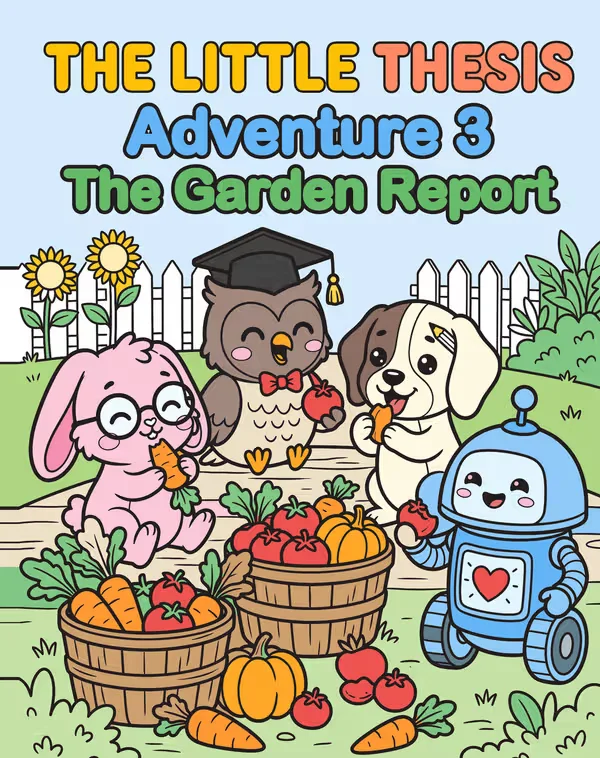
Kids can learn what happens after the money arrives.
The Problem
Most people learn about final reports the hard way, with a funder waiting and a season of work to explain. They never watched anyone count what actually happened, compare it with the plan, admit what did not work, and write it down anyway. So the report feels like a test to pass instead of the most useful part of the project.
The Solution
The Garden Report walks ages 4 to 8 through a complete research report: ask the big question, count the harvest, ask the neighbors the same questions again, compare before and after, find out why the pumpkins stayed small, and share what worked and what did not. 101 crayon-friendly pages, the same four friends, and a Junior Garden Reporter certificate at the end.
Six steps. One honest report, start to finish.
Every coloring page belongs to a stage of the report. Counting, weighing, bar graphs, a repeat survey, and draw-your-own pages sit inside the story instead of beside it.
Step 1: Ask the big question
A whole season later, the garden is full and the pigeon brings a letter from the Tortoise. Did our garden really help? Before anyone starts checking, the team lists the ways they could tell.
Step 2: Count the harvest
Harvest day. Carrots, tomatoes, and pumpkins get picked, weighed, tallied, and turned into a bar graph. Count the little pumpkins hiding in the leaves, and notice that none of them are big.
Step 3: Ask the same questions again
Remember the neighbor survey from the grant? The team knocks on the same doors and repeats it word for word, so this year’s answers can be compared with last year’s.
Step 4: Compare before and after
Twelve neighbors became twenty. Color the before-and-after graph, ask which number is bigger, and see what changed. That is the proof the garden did what the proposal promised.
Step 5: Find out why
Why did the pumpkins stay so small? Did a bug eat them? Did they get enough water? The team follows the clues to the sunniest spot and finds the pumpkin patch was in the shade all day. Even a "no" is a discovery.
Step 6: Write and share the report
What goes in a report? What we did, what we found, what we learned, and what we will do next. Check it twice, tie it with a ribbon, and read it aloud to the Tortoise, who passes it on to other gardens. The book ends with the question: what will we study next?
The research team is back.
The four friends from Book 1 and Book 2 return to the garden they built, with the Tortoise waiting for their report and a pigeon carrying the mail.
Curious Bunny
The Questioner
Reads the Tortoise’s letter and asks the question the whole book answers: did our garden really help? Keeps asking why until the pumpkin mystery is solved.
Professor Hoot
The Mentor
Explains what a report is for and why the survey has to use the same questions as before. Writes down every neighbor’s story, then practices reading the report out loud.
Detail Dog
The Counter
Makes a tally mark for every carrot and tomato, weighs the harvest, adds up all the yes answers, and checks everything twice before the report goes out.
Subby the Robot
The Planner
Turns the counts into a graph, draws the before-and-after graph, makes a picture of every answer, and puts the graphs and pictures together into the report.
Why this works for kids.
Reporting is research, round two
Book 1 taught the question, Book 2 taught the proposal, and this book closes the loop. Kids see that the same habits (count, ask, compare) tell you whether an idea worked.
A "no" is a discovery
The pumpkins stayed small. The book treats that as the most interesting page in the report, follows the clues to the shade, and turns it into next year’s plan. Most adults learn to hide results like that.
A certificate closes the loop
Kids finish as an Official Junior Garden Reporter, with proof they measured, compared, explained, and shared. The identity shift is the point, same as the diploma and certificate in the first two books.
Built for the people teaching the next generation.
Parents
For the parent who wants their kid to learn that finishing means telling people what happened, including the parts that did not work. A full story with a mystery in the middle and a report at the end.
K-2 Teachers
Counting, measuring, tally marks, before-and-after bar graphs, cause and effect, and informational writing in one book. Fits a plants unit, a data unit, or the end of a real class garden.
Grant Writers & Researchers
The gift for the kid who asks what a final report is. Also an honest picture of program evaluation: the same instrument twice, a comparison, a null result explained, and a report the funder passes on.
Count, Ask, Compare
Give a child a real research report they can color: a letter from the funder, a harvest to count, a survey to repeat, a graph to compare, a pumpkin mystery to solve, and a report to share. The same four friends, one new lesson about telling people what happened.
Paperback • $11.99 • Available Now